The engineering record for a mine, from first pit to closure.
A mining operation documents the pit, the fixed plant, and the infrastructure around them for decades: general arrangements for the crushing and milling circuit, P&IDs, electrical reticulation, structural steel details, and the drawings for the tailings storage facility. They arrive through every expansion and outsourced EPC project, and they have to hold long after production ends. Lunr puts that record under revision control, makes the text inside a scanned plant drawing searchable, opens the current sheet from a work order or the site map, makes contractor handover arrive complete, and keeps the closure record with the operator after the mine is gone.
10M+ documents under management · Hosted in Australia and the US · SAML · Full audit trail · Export anytime
Every drawing on the mine and the plant in one register.
A mine spreads across the pit, the fixed plant, the tailings storage facility, the workshops, and the camp, and each area carries its own set. Group them into Portfolios, keep every drawing under revision control, and a superseded sheet is never mistaken for the current one.
- Hold DWG, DGN, RVT, and PDF drawings under one numbering scheme, alongside the specifications, reports, and vendor manuals that go with them.
- Group the site into Portfolios by pit, plant, and facility, each carrying its own asset information.
- Automatic document and version numbering, applied in your register format as records are booked in.
- Read title-block tags off every sheet into metadata, so nobody retypes the number, the discipline, or the revision.
- Compare two revisions side by side, or overlay them to see what moved between REV B and REV C.
Portfolios · DWG · DGN · RVT · PDF · automatic numbering · title-block tags · revision compare
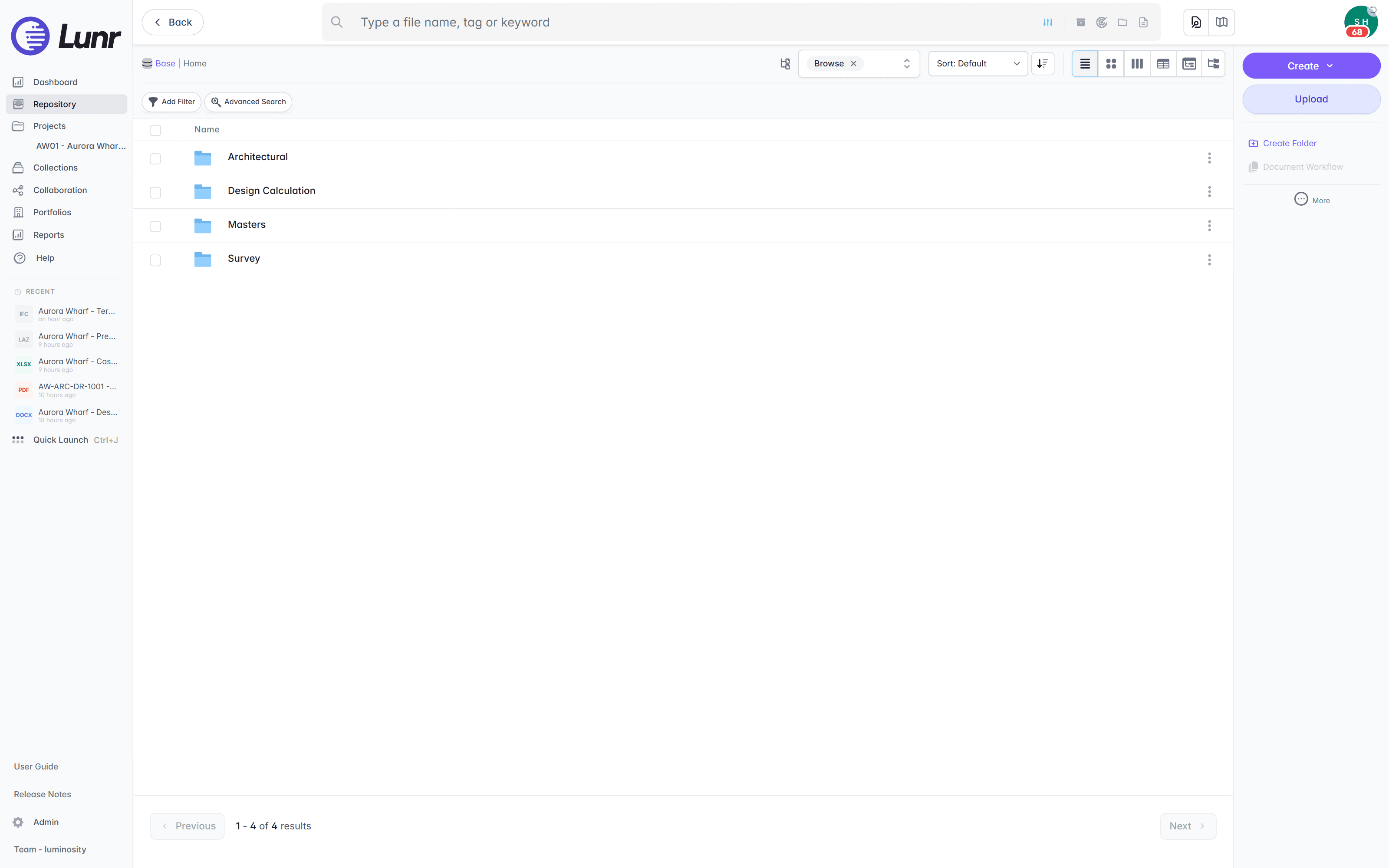
A closure record that outlives the mine.
A mine outlives the people, the fleets, and the firms that document it, and the record has to be kept for closure and rehabilitation long after production stops. Keep every drawing under revision control, so a superseded sheet is never mistaken for the current one, and keep a full audit log behind every change, ready for an assurance review years later.
- Hold decades of drawings for the mine site and processing plant under revision control.
- Automatic document and version numbering, applied in your register format as records are booked in.
- A full revision history on every drawing, so any change can be traced and evidenced.
- Export all metadata, drawings, and models at any time, so the closure record stays with the operator.
revision control · automatic numbering · audit log · records custody · export anytime
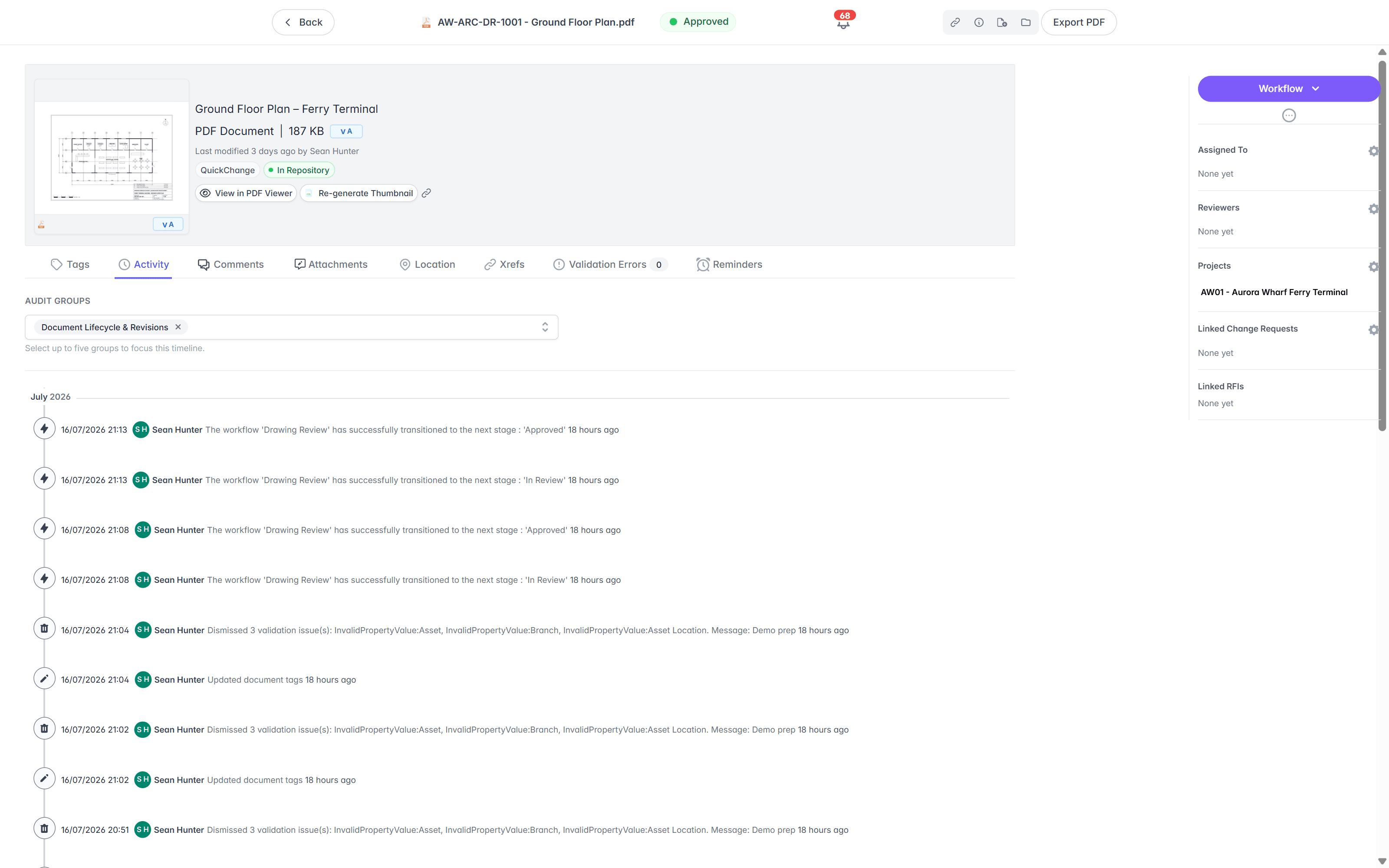
As-constructed sets that arrive complete at every expansion.
A mine grows in expansions, each one delivered by EPC contractors, and the record only stays whole if handover is checked on the way in. Validate each package against a manifest, so a missing as-constructed drawing is caught on upload, not discovered on the next expansion.
- Validate each handover package against a manifest, and read title-block tags into metadata.
- Issue tracked transmittals, and run change requests that hold, forward, and close.
- Move deliverables through configurable review and approval workflows.
- Contractors and consultants deliver as Collaborators, and see only what you grant them.
manifest validation · transmittals · change requests · configurable workflows · Collaborators
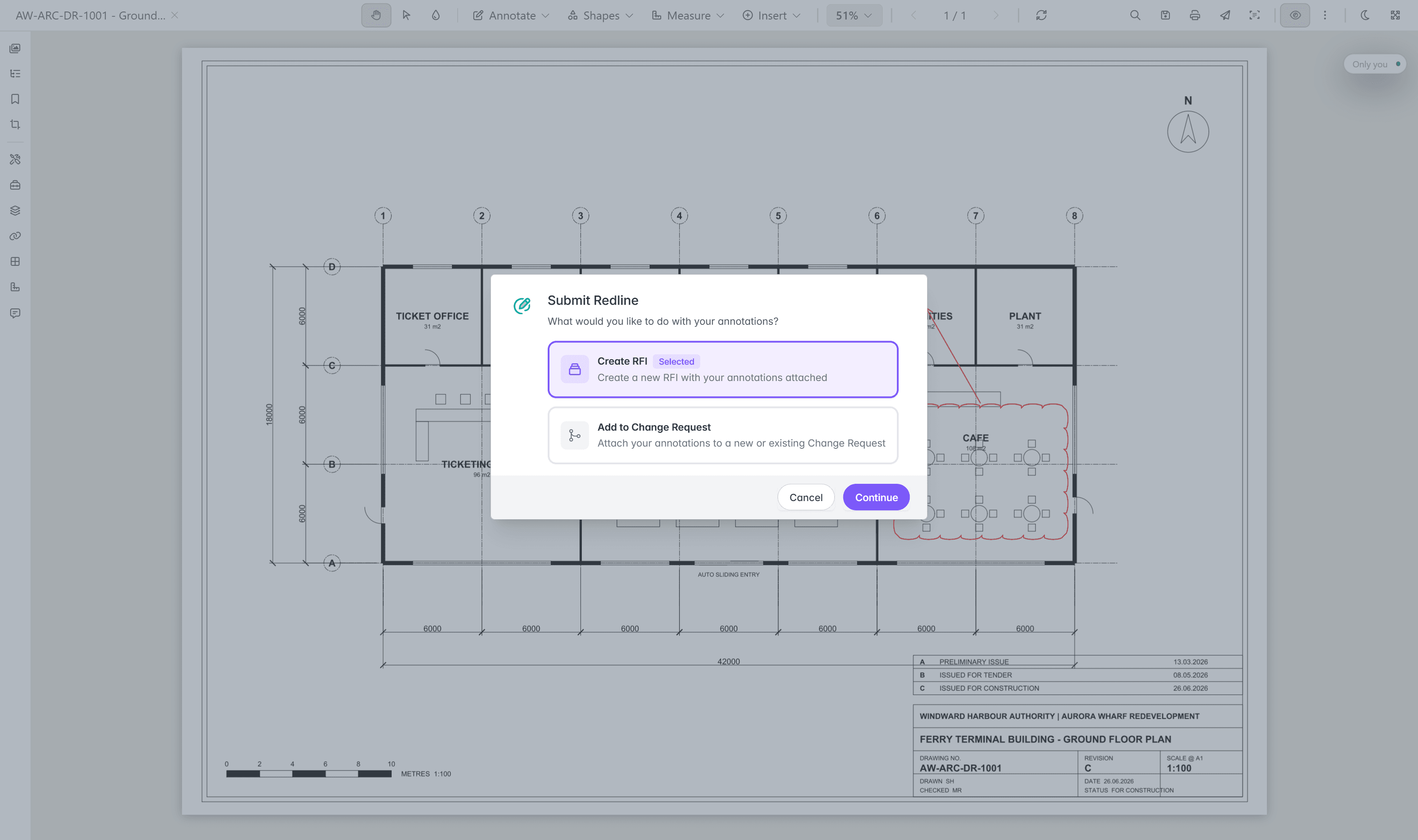
Staff see the drawing without a CAD licence.
Most of the people who need a mine or plant drawing do not run CAD. The Rift viewer renders DWG, DGN, and PDF at full fidelity in the browser, with layers, measurement, and markup, so plant, maintenance, and site engineering staff review a drawing without a seat. Models open in Foundry, point clouds in Nimbus.
- View DWG, DGN, RVT, and PDF in the browser, with no CAD licence and nothing to install.
- Toggle layers, measure, and mark up the drawing straight in the viewer.
- Open BIM models in Foundry and point clouds in Nimbus from the same record.
- Turn a redline into a change request or an RFI without leaving the viewer.
browser viewers · layers · measurement · markup · no CAD licence
Try the viewers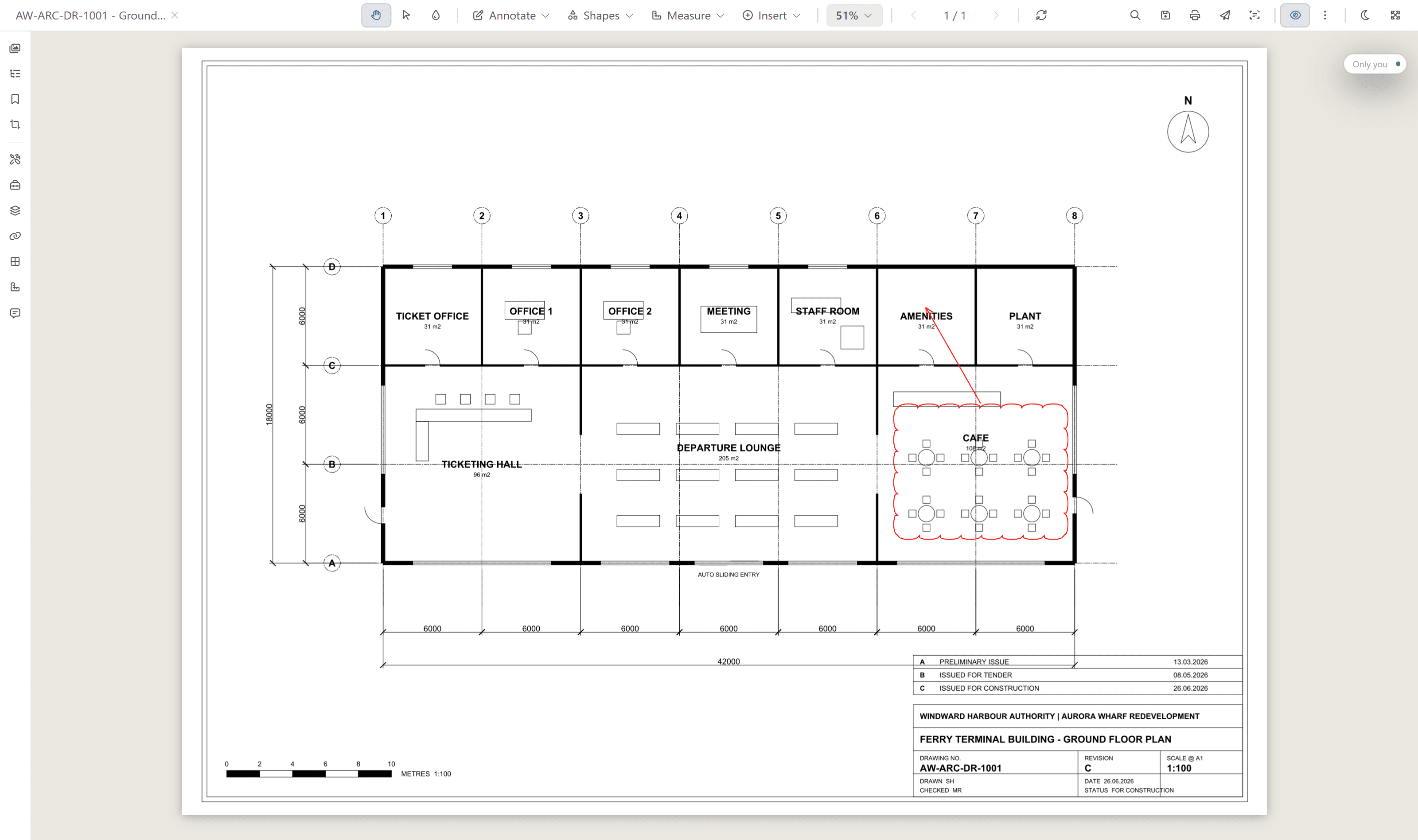
And out on site, where there is no reception.
Download the documents a shutdown needs as a collection before the crew goes out, and read them underground or out on the lease. The collection carries an expiry set by your organisation, access refreshes when the handset next signs in online, and the files held on the device carry app-level and file-level encryption.
See the mobile apps- Take documents offline as a collection, with their metadata, from the iPhone and Android apps.
- Scan the QR code in a printed title block on the plant, and Lunr opens the live controlled document at its current revision.
- Raise a comment, a change request, or an RFI from the field, and attach a photo taken with the camera.
- Move a controlled document to its next state on the workflow your organisation configured.
offline collections · encrypted on device · document QR · field change requests · iOS and Android
Search the words inside a scanned plant drawing.
A site archive runs back to plans drawn long before CAD, and much of it is scanned. XRAY runs OCR and full-text search across every drawing, scans included, so a line number, an equipment tag, or a note is findable whether the sheet was saved this morning or scanned from a decades-old archive.
- OCR and AI full-text search across every DWG, DGN, RVT, PDF, and scanned image.
- Find a line number, an equipment tag, or a note printed inside the drawing, not just the file name.
- Deep XRAY re-scans a dense P&ID or general arrangement tile by tile, so nothing on the drawing is missed.
- Filter results by metadata, tags, and revision to narrow a large site archive fast.
OCR · AI full-text search · deep XRAY tile re-scan · metadata and tag filters
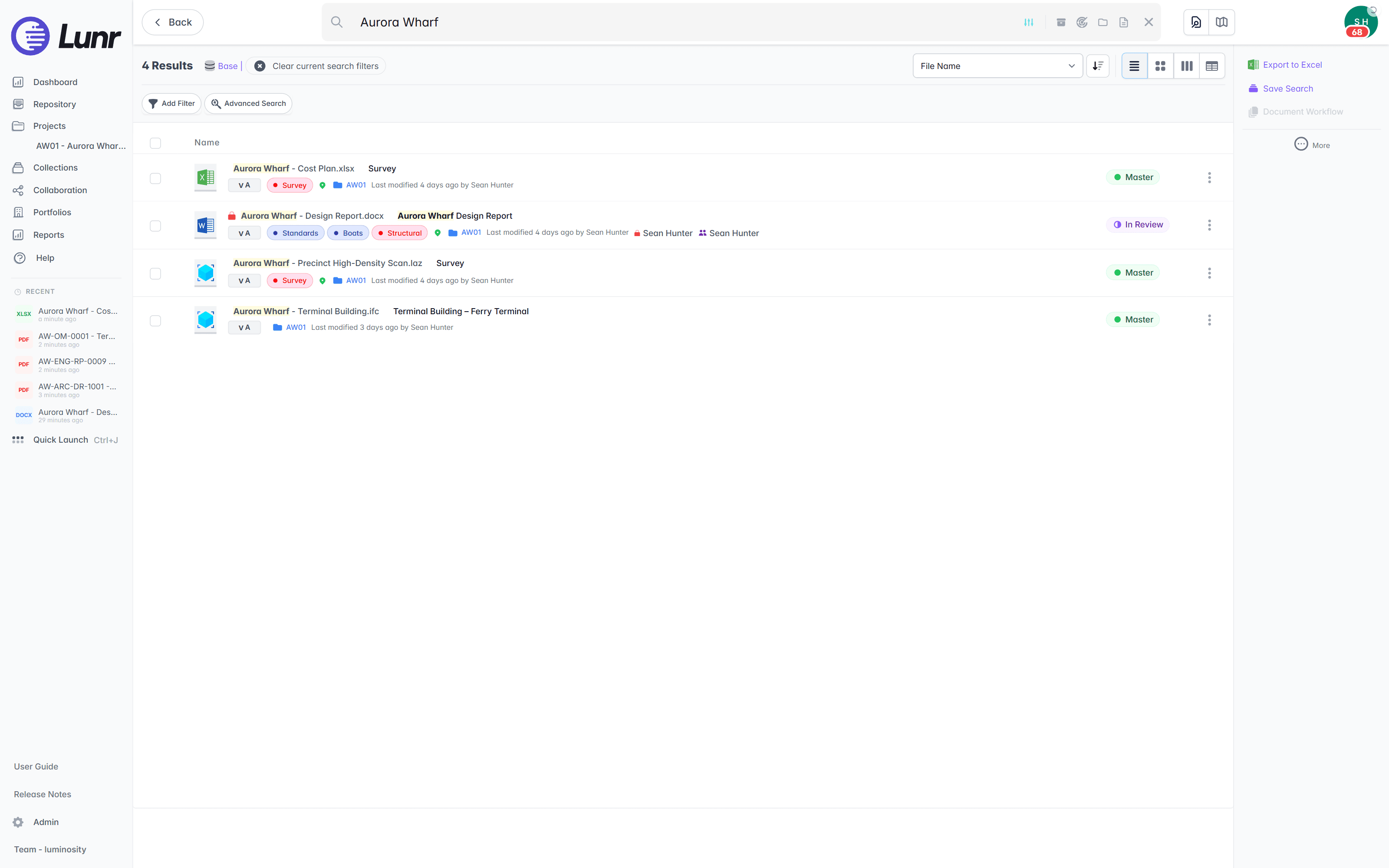
Open the drawing from the map, or from a work order.
A mine spreads across a lease, from the pit to the plant to the tailings facility, and the two places staff already start are the site map and the work order. Lunr meets both: each document carries a location per asset synced from your GIS, and your asset and works management systems resolve a document link from an asset ID over the REST API.
Your GIS layers, and a location on every document.
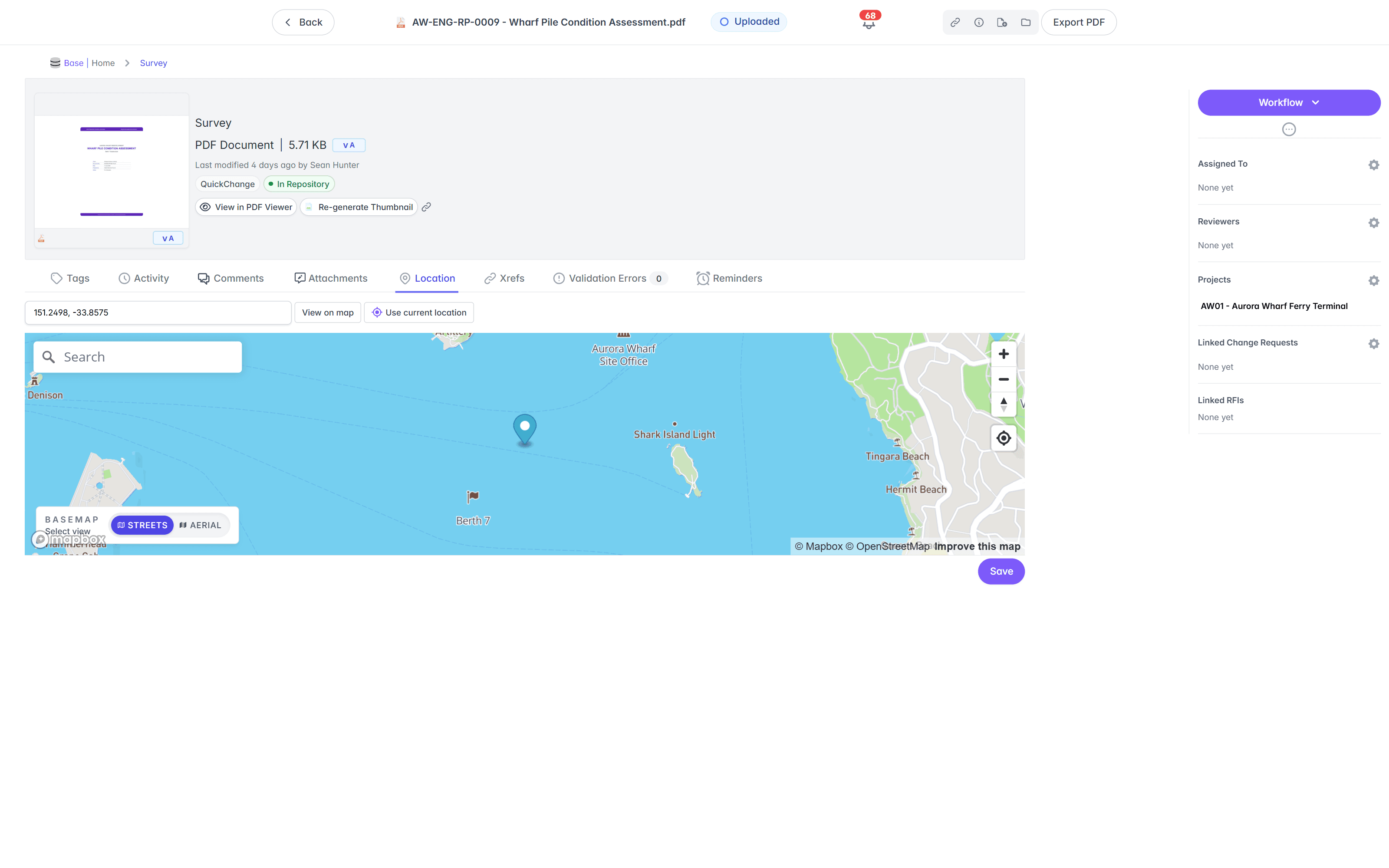
A document version holds one location for each asset it covers, as a point, a line, or a polygon, keyed on the GIS asset ID held as a document tag. The sync resolves those tags against your ArcGIS as part of document synchronisation.
- Render your ArcGIS Online feature-service layers live on the Lunr map, queried for the current view, with nothing copied into Lunr.
- See every geo-tagged document on the map, clustered by location.
- Draw a polygon around the pit, the plant, or a tailings facility, and Lunr returns every document inside it.
- Browse the record from where you stand on site.
Esri and ArcGIS · live feature-service layers · one location per asset · polygon search · field access
See the Esri and ArcGIS integration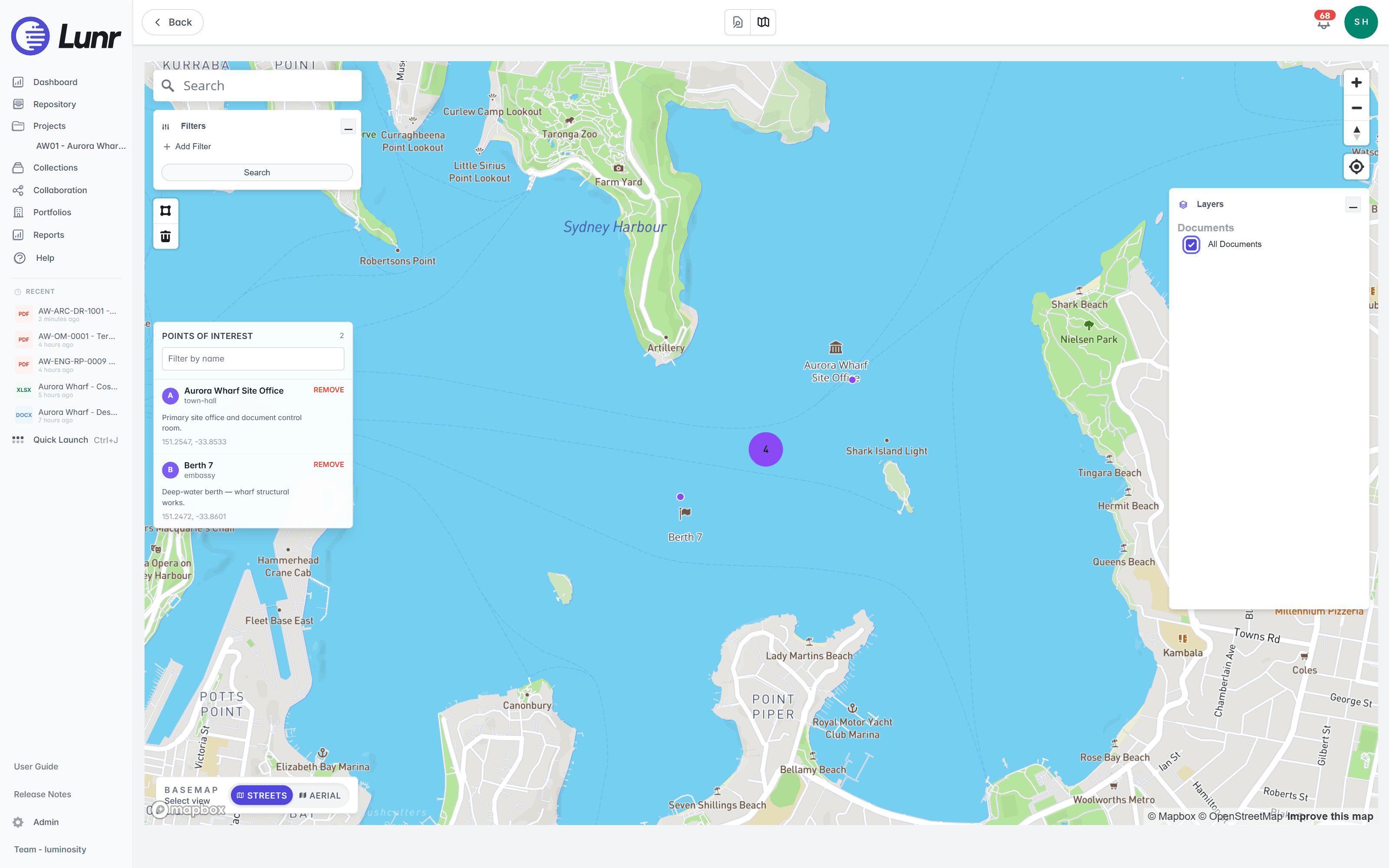
A work order that opens the current revision.
Your asset and works management systems run the asset register and the maintenance work. Lunr holds the drawing record against the same asset IDs, and the two meet over the REST API. Pass an asset ID, get the documents that cover it.
- Resolve a document link from an asset ID, so maintenance runs against the current revision rather than a superseded sheet.
- Query the drawing register over the REST API, so the asset system reads Lunr rather than holding its own copy of the documents.
- Serve document locations as a GeoJSON FeatureCollection, and add that endpoint to ArcGIS as a layer to find Lunr documents from the GIS side.
- Scope each integration during implementation, against your asset IDs and your tag scheme, rather than installing a packaged connector.
REST API · asset ID to document links · GeoJSON layer · TechnologyOne · WorxOnline · Maximo · scoped in implementation
Built to clear a mining tender.
The answers a tender panel and a CISO look for are already in place. Pricing is shaped to your organisation, with every capability included as standard.
Data centres in Australia and the US. Your instance sits in the region you require, so records stay onshore.
Lunr is hosted and implemented by Onset Design, which maintains ISO/IEC 27001:2022 compliance, and Lunr runs on that certified infrastructure. The certification is held by Onset Design, the partner that hosts and operates Lunr. Read the security page.
Staff sign in with your identity provider. Contractors and consultants join as Collaborators.
Every controlled document carries a full revision history and audit log, ready for an assurance review.
Export all metadata, drawings, and models at any time. The record stays with the operator.
Every capability is standard, with pricing shaped to your organisation. Evaluation is fast, not a discovery project.
An accessibility statement is published and maintained for the browser workspace.
Read the accessibility statement, or connect the GIS, EAM, and CAD systems your site already runs on the connectors page.
Trusted with records owners keep for decades.
Metals and mining is one of the sectors already running its engineering record on Lunr, and the team behind your implementation has spent twenty years moving those records at Australian asset owners.
Higher education, utilities, infrastructure, life sciences, and metals and mining run their engineering record on Lunr, and Lunr has been selected through RFQ tender processes. We name the organisations in a walkthrough, where we can talk through the work.
Read how Lunr is securedof engineering document migrations at Australian asset owners, across utilities, power generation, manufacturing, mining, and education. Millions of documents have moved under this method, off network drives, SharePoint, and legacy document systems.
See how implementation runs“Lunr is a simple solution that provides the flexibility to develop the system to our needs. Lunr is simple to use, and minimal training is required.”
10M+ documents under management on Lunr today.
Read the University of Canberra case studyQuestions mining teams ask about drawing management.
How the record is held today, what becomes of it at closure, how handover works on an expansion, and where the data sits.
- How do mining operators manage engineering drawings today, and how is Lunr different?
- Most operators keep drawings in nested folders on SharePoint or a shared drive, split across the mine site, the processing plant, disciplines, and outsourced EPC contractors. The current revision is a guess, superseded sheets stay in circulation, the text inside a scanned plan is invisible to search, and there is no audit trail. Lunr puts every drawing under revision control in one register, keeps the superseded copy marked, searches the words printed inside each sheet, and logs every change. The University of Canberra moved more than 20,000 documents off SharePoint onto Lunr for this reason.
- What does engineering drawing management for a mining operation have to cover?
- One register across the whole operation, not one per area. It has to hold the pit, the fixed plant, the tailings storage facility, the workshops, and the camp, in DWG, DGN, RVT, and PDF, alongside the specifications, reports, and vendor manuals that belong with them. Each drawing needs a number from your scheme rather than a file name, every revision kept with the superseded copy marked, the text inside a scanned sheet searchable, a location against the asset it covers, and handover validated on the way in. Lunr does all of that in one register, and holds more than 10 million documents today.
- Can our asset or works management system open the current drawing from a work order?
- Yes. Your asset and works management systems run the asset register and the maintenance work, Lunr holds the drawing record against the same asset IDs, and the two meet over the REST API. Pass an asset ID and get the documents that cover it, so maintenance runs against the current revision rather than a superseded sheet. Systems such as TechnologyOne, WorxOnline, and Maximo connect this way, scoped to your asset IDs and your tag scheme during implementation rather than installed as a packaged connector. Lunr also serves document locations from the REST API as a GeoJSON FeatureCollection, so you can add that endpoint to ArcGIS as a layer and find Lunr documents from the GIS side.
- What happens to our records when the mine closes?
- The engineering record has to be kept long after the mine stops producing, for closure, rehabilitation, and the obligations that follow. Lunr keeps every drawing, its revision history, and the full audit trail past the operating life of the mine, and you can export all metadata, drawings, and models at any time, in bulk. The custody of the record stays with the operator, not the vendor, so a closure record survives the end of the mine.
- How does Lunr handle contractor handover on an expansion?
- Every expansion is delivered by contractors, and the record only stays whole if handover is checked on the way in. Validate each handover package against a manifest, so a missing as-constructed drawing is caught on upload rather than found on the next expansion. Lunr reads title-block tags from every sheet into metadata, applies your register numbering as records come in, and issues tracked transmittals, so the delivered set arrives complete and lands in the register the moment the contractor hands it over.
- Can staff without a CAD licence view drawings?
- Yes. Anyone with access opens DWG, DGN, and PDF drawings in the browser through the Rift viewer, with layers, measurement, and markup, and nothing to install. Models open in Foundry and point clouds in Nimbus. A CAD seat is only needed to author drawings, so plant, maintenance, and site engineering staff can see the drawing without one.
- Can Lunr search inside our scanned plant and site drawings?
- Yes. XRAY runs OCR and full-text search across every drawing, scans included, so a line number, an equipment tag, or a note printed on a plan is findable whether the sheet was saved this morning or scanned from a decades-old archive. Deep XRAY re-scans a dense P&ID or general arrangement tile by tile, so nothing on the drawing is missed. Filter results by metadata, tags, and revision to narrow a large site archive fast.
- Where is our data hosted, and does it stay onshore?
- Lunr is hosted in Australia and the US, and your instance sits in the region you require, so records stay onshore for data sovereignty. Staff sign in over SAML with your identity provider, external parties join as Collaborators, and every controlled document carries a full audit trail. Over 10 million documents are under management on Lunr today.
Ten more sectors, documented the same way.
Each page below covers the documents that sector holds, the archive it inherited, and the systems its record has to sit beside. The platform is the same one, configured to the assets you run.
buildings · plant rooms · services
University estates
A campus estate of DWG, DGN, and RVT under revision control, with the scanned archive searchable and contractor handover checked on every project.
networks · substations · plants
Utilities and energy
Networks, substations, and generation plants documented across decades, searchable back through the scanned archive and findable on the network map.
plants · pump stations · mains
Water authorities
Treatment plants, pump stations, reservoirs, and the reticulation network, with one location per asset synced from your GIS.
roads · water · buildings
Government and councils
Roads, water, buildings, and parks under revision control, so the record stays with the public owner through staff turnover and outsourced engineering.
civic buildings · roads · drainage
Local councils
Civic buildings, roads, and drainage assets linked to council GIS and asset systems, with the inherited scanned archive searchable.
corridors · signalling · structures
Rail operators
Corridors, signalling, and structures under revision control, with scanned legacy drawings searchable inside the sheet.
airfield · terminals · services
Airports
Airfield, terminals, and services under revision control, with decades of scanned drawings searchable inside the sheet.
equipment · P&IDs · layouts
Manufacturing
Mechanical, electrical, P&ID, and layout drawings, with the current revision readable at the machine on a QR scan.
wards · plant · services
Hospitals and healthcare
Engineering services drawings for a hospital campus, kept complete through constant refurbishment and searchable back through the scanned archive.
cleanrooms · HVAC · P&IDs
Life sciences facilities
Cleanroom layouts, HVAC, water systems, and P&IDs for a pharmaceutical plant, laboratory, or biotech site, with every superseded revision kept.
For what every one of these sectors has in common, and how an owner’s record differs from a delivery system, read engineering document management.
See it on your own mine and plant drawings.
Book a walkthrough with someone who knows what a transmittal and an as-constructed set are, and we will map Lunr to your site.
10M+ documents under management · Hosted in Australia and the US · SAML · Full audit trail · Export anytime
- entity
- Lunr Labs Pty Ltd
- location
- Melbourne AU
- workspace
- documents.lunr.app
- rev
- 2026