An Oracle Aconex alternative built for the asset owner.
For the asset owners and document controllers who hold the record after the project team goes home. Aconex runs project delivery well. Lunr takes the controlled set at handover and keeps it live for the operating life of the asset, with a register you own, browser viewing, and search inside every scanned sheet.
10M+ documents under management · Hosted in Australia and the US · SAML · Full audit trail
Aconex is strong software, for the job it was built for.
Aconex is a common data environment for project delivery, and it coordinates the mail, transmittals, and workflows across every party through design and construction. Plenty of owners should keep it for exactly that. The claim here is narrow. Aconex is built for delivering a project, and the record an owner runs for decades of operation needs things a delivery environment does not hold.
Lunr is built for the owner’s record. It takes the controlled set at handover and keeps it live through operation, while Aconex keeps running the projects that feed it.
Read why owners keep the drawing record on their own system- Project delivery, where many organisations coordinate through design and construction.
- Mail and formal correspondence, with RFIs, instructions, and notifications on the record.
- Transmittals that issue documents between project parties and log receipt.
- Review and approval workflows that move a submittal through the delivery team.
Where a delivery environment hits the edge of the owner’s record.
These are the specific points where Aconex stops matching what an asset owner needs after handover. Each one is a job the owner’s record has to do for the operating life of the asset, and a project-delivery CDE was built for something else.
Aconex and Lunr, capability by capability.
A factual read of what each tool does across the asset lifecycle. The two are not rivals for every row. Aconex runs project delivery, and Lunr holds the record the owner keeps after handover.
| Capability | On Aconex | On Lunr |
|---|---|---|
| Coordinate document exchange across project parties in delivery | Yes, its core strength | Not its role; Lunr is the owner's record |
| Mail, RFIs, and formal project correspondence | Yes, on the delivery record | Stays in delivery, referenced from the record |
| Transmittals issuing a document set | Yes, between project parties | Yes, from the owner's register |
| A live controlled register held after the project closes | Archive access, read only, subscription-bound | Yes, a live register the owner holds |
| One complete controlled set for the asset | Each organisation owns its own data | The owner holds a single controlled set |
| Revisions and as-builts land through operation | Built for delivery, not the operating phase | Yes, the register stays live for the asset's life |
| Full-text search inside scanned drawings | Search across registered documents | Yes, XRAY OCR reads the text on the sheet |
| Owned system of record for decades of operation | Project archive, retained by subscription | The owner's system of record, held as their own |
A live register the owner holds, not an archive of a closed project.
Take the controlled set at handover and Lunr numbers it in your register format, keeps the full revision history, and marks the previous revision as superseded. The title-block fields come across as searchable metadata, so drawing number, revision, and discipline are things you filter on. Then the register stays live, and new revisions and as-builts land straight against it through operation.
- A controlled register the owner holds, showing the current revision and status of every sheet at a glance.
- Automatic document and version numbering, applied in your register format as drawings are taken on.
- Superseded revisions kept and marked, so the current sheet is never a guess years into operation.
- Title-block tags read into metadata, so the drawing number, revision, and discipline become filters.
owner’s register · automatic numbering · superseded marking · title-block metadata
See document control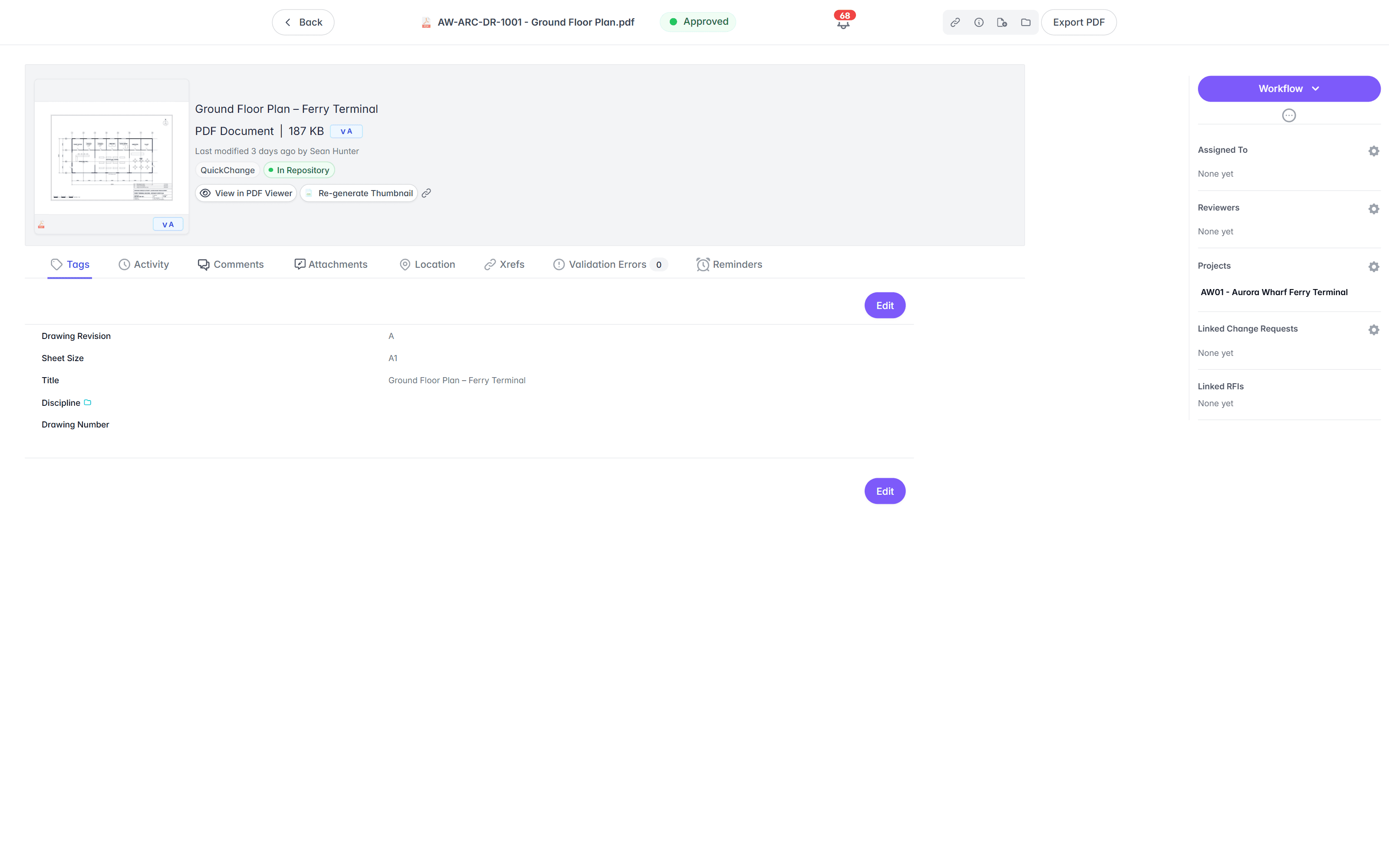
Open a DWG, DGN, or RVT in the browser, no CAD licence.
The operations team is not the delivery team, and most of them never had a CAD seat. In Lunr the Rift viewer renders DWG, DGN, and PDF at full fidelity, with layers, measurement, and markup, so anyone maintaining the asset can open the sheet. Models open in Foundry, point clouds in Nimbus.
- View DWG, DGN, RVT, and PDF in the browser, with no CAD licence and nothing to install.
- Toggle layers, measure, and mark up the drawing straight in the viewer.
- Open BIM models in Foundry and point clouds in Nimbus from the same record.
- Turn a redline into a change request or an RFI without leaving the viewer.
browser viewers · layers · measurement · markup · no CAD licence
Try the viewers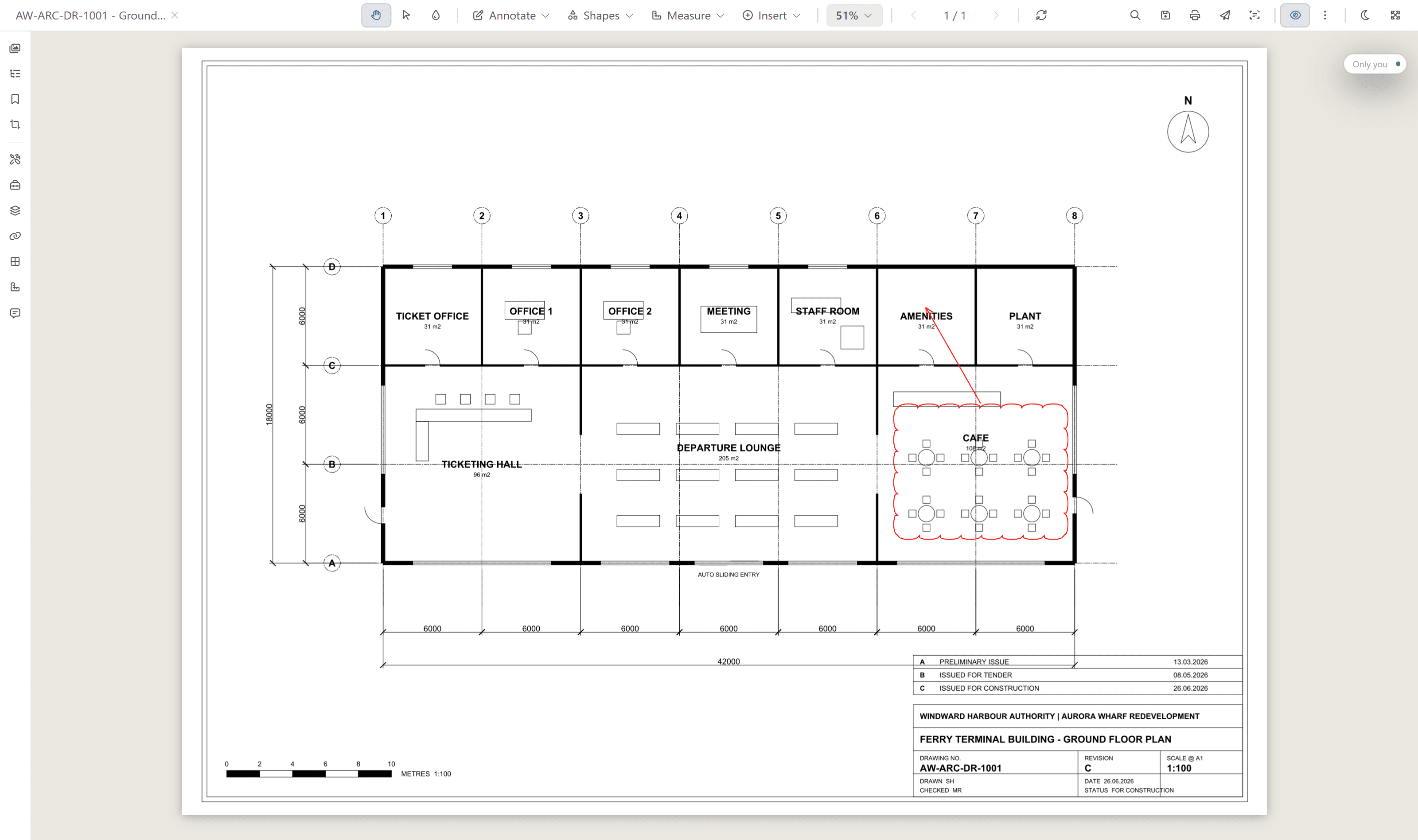
Search the words printed inside a scanned drawing.
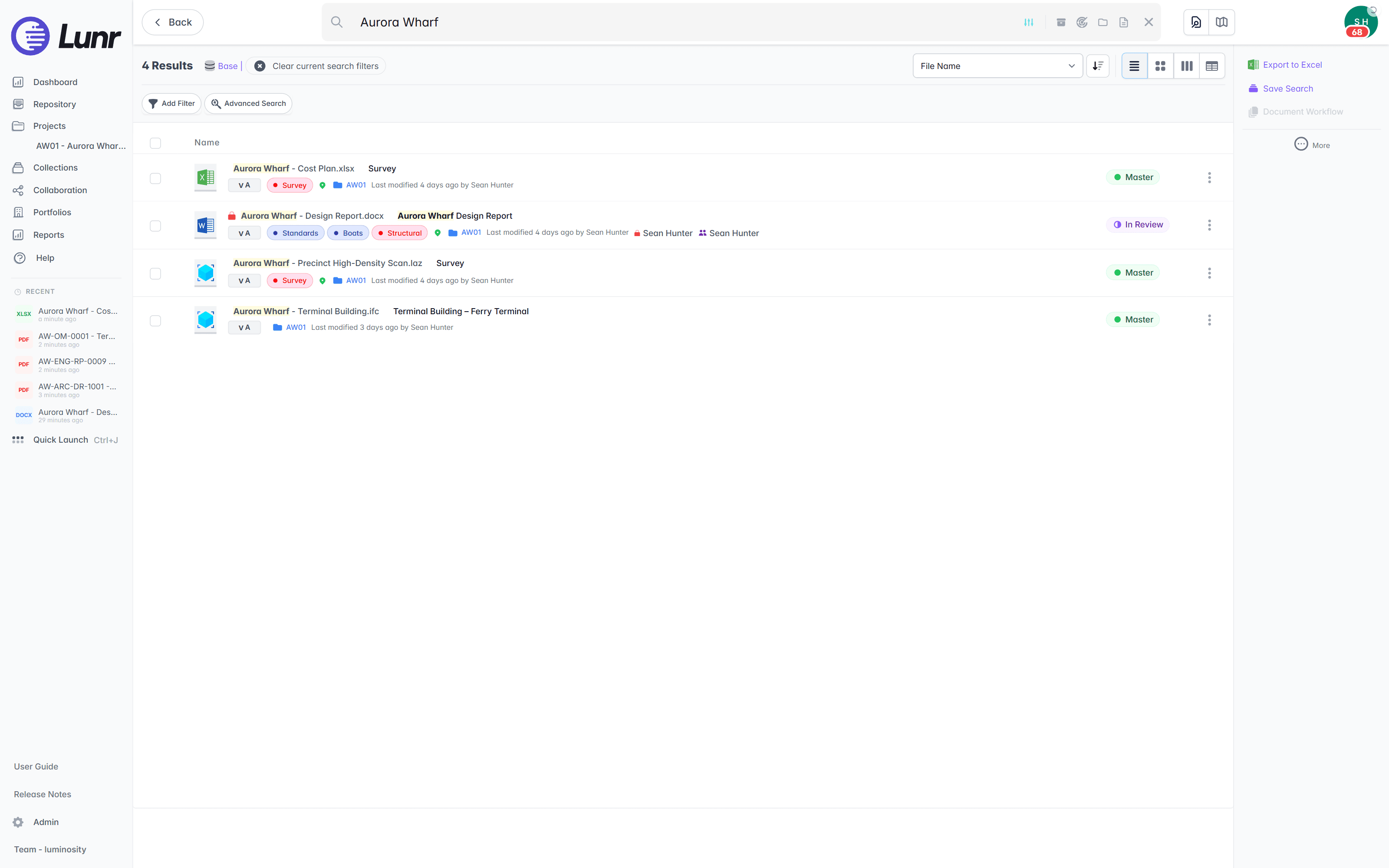
An owner inherits decades of drawings, and much of the archive is scanned. XRAY runs OCR and full-text search across every drawing, scans included. Search a valve tag, a title-block reference, or a note, and Lunr returns the sheet whether it came from this year’s handover or a 1994 archive.
- OCR and AI full-text search across every DWG, DGN, RVT, PDF, and scanned image.
- Find a tag, a reference, or a note printed inside the drawing, not just the file name.
- Deep XRAY re-scans a dense sheet tile by tile, so nothing on the drawing is missed.
- Filter results by metadata, tags, and revision to narrow a large set fast.
OCR · AI full-text search · deep XRAY tile re-scan · metadata and tag filters
Take handover on the record, with an audit trail behind it.
Lunr validates each handover package against a manifest, so a missing as-constructed drawing is caught on upload rather than found years into operation. It issues transmittals from the owner’s register, moves operational revisions through configurable review and approval, and keeps a full audit trail behind every approval, revision, and change.
- Validate each handover package against a manifest, and read title-block tags into metadata.
- Issue tracked transmittals from the owner's register, and run change requests that hold, forward, and close.
- Move operational revisions through configurable review and approval workflows.
- Keep a full audit trail on every controlled drawing, ready for compliance and audit.
manifest validation · transmittals · change requests · configurable workflows · full audit trail
See handover and transmittals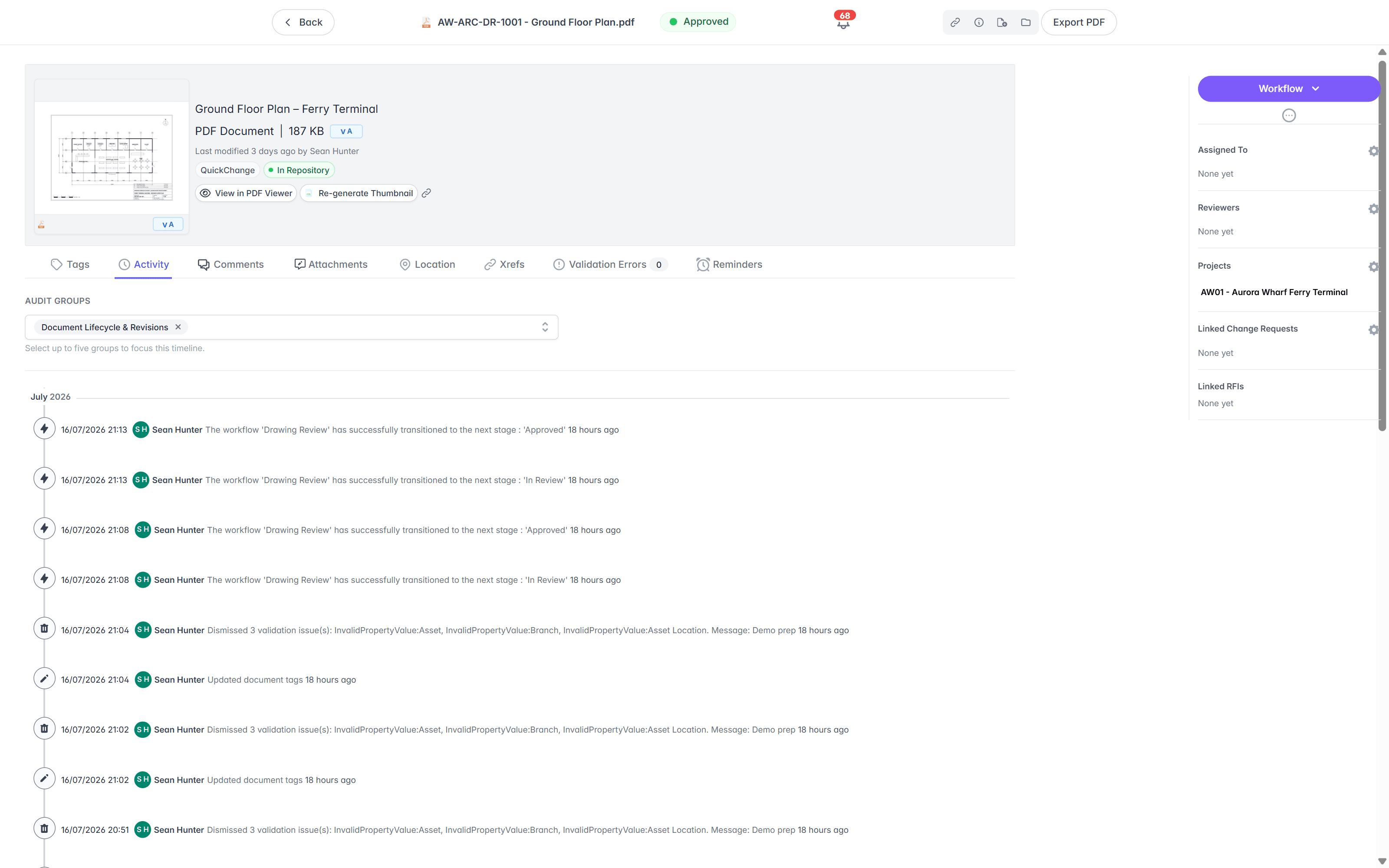
Take the record across at handover, keep Aconex for delivery.
You do not have to leave the record in a read-only archive or rebuild it by hand. Import the handover package, validate it against the manifest, and open the register for operations. The owner’s record moves to Lunr, and Aconex carries on delivering the next project.
- 01Take handover in bulk
Point Lunr at the handover package from Aconex, and it reads the title-block tags from each sheet into metadata, so drawing number, revision, and discipline become fields the owner can filter on.
- 02Validate against the manifest
Each handover package is checked against a manifest as it lands, so a missing as-constructed drawing is caught on upload rather than found years into operation.
- 03Open the register for operations
The controlled set becomes a live register the owner runs, where new revisions and as-builts land through the operating life of the asset, rather than a read-only project archive.
- 04Keep Aconex for the next project
Delivery teams carry on running projects in Aconex, and each project hands its controlled set to the owner's register in Lunr, so the two sit side by side.
See the CAD, GIS, and facilities connectors that keep the owner’s record fed on the connectors page.
Alternatives to Aconex, and when to stay put.
Owners look for an Aconex alternative for three consistent reasons: a record that goes read only when the project closes, data owned by each contributor rather than assembled into one controlled set, and a scope that stops at delivery while the asset runs for decades. Which alternative fits depends on which of those you are solving.
InEight Document, built by Melbourne's QA Software and long established across Australian infrastructure, oil and gas, power, and mining. The closest like-for-like swap for delivery-side document control.
The common data environment inside Autodesk Construction Cloud, certified against ISO 19650. Strongest where the project is authored in Revit and AutoCAD and the team already works in that toolchain.
Bentley's design collaboration environment, aimed at live work in progress rather than correspondence across parties. The right answer where the pain is design coordination on MicroStation and DGN.
Construction management, where drawings sit beside budgets, schedules, submittals, and the field. Owners running the build itself often want this rather than a document exchange platform.
Data management and worksharing for civil engineering and surveying offices, with an ISO 19650 common data environment and deployment on 12d's cloud, your own servers, or your own cloud.
The owner's controlled register from handover onward. Browser viewing with no CAD licence, OCR search inside scanned sheets, handover validated against a manifest, and hosting in Australia or the US.
When staying on Aconex is the right call
Stay while a project is live and many organisations exchange formal mail, transmittals, and submittals through it. Few tools coordinate that many parties as well, and swapping platforms mid-delivery costs more than it saves. The gap opens at project close, so the useful move for most owners is to add a register that takes the controlled set at handover, rather than to replace the environment running the job.
Read the whole field first
Every product above is covered alongside SharePoint, OpenText, M-Files, Autodesk Vault, Synergis Adept, and Accruent Meridian in the survey of engineering document management software, with the six criteria to put to each vendor. The comparisons hub goes deeper on the ones owners ask about most.
Owners already run the record this way.
Universities, utilities, energy companies, and government departments run their drawing record on Lunr, taking it at handover and keeping it live through the operating life of the asset.
documents under management on Lunr. Proof the owner’s record holds up at owner-and-portfolio scale.
“Lunr is a simple solution that provides the flexibility to develop the system to our needs. Lunr is simple to use, and minimal training is required.”
Questions owners ask about Aconex and the record after handover.
What Aconex does through delivery, which alternatives suit which job, what changes when the project closes, and what it takes to keep the record live for the operating life of the asset.
- Is Lunr an alternative to Oracle Aconex?
- For an asset owner, yes. Aconex is a common data environment built for project delivery, and it coordinates the mail, transmittals, and workflows across every party through design and construction. Lunr is the owner's system of record from handover onward. The two are not rivals during delivery. The alternative Lunr offers is to the practice of leaving the record in a delivery archive once the project closes, when the owner needs a controlled register they hold for decades of operation.
- What are the alternatives to Oracle Aconex?
- It depends which job you are replacing. For delivery-side document control across many organisations, TeamBinder, now InEight Document, is the closest like-for-like swap, and Autodesk Docs suits teams already authoring in the Autodesk toolchain. For design work in progress, ProjectWise and 12d Synergy are aimed at that instead. For running the build with drawings beside budgets and the field, Procore fits. For the owner's record after handover, the field is purpose-built engineering document management: Lunr, Synergis Adept, and Accruent Meridian. The engineering document management software survey on this site sets all of them out side by side.
- Should you replace Aconex, or add a system of record alongside it?
- Most owners should add rather than replace. Aconex is the right tool while a project is live and many organisations exchange formal correspondence, transmittals, and submittals, and swapping it out mid-delivery costs more than it saves. The gap opens at project close, when the environment moves to read-only archive access and the operating record still has decades to run. Adding an owner's register that takes the controlled set at handover fixes that without disturbing delivery, and each future project hands its set to the same register.
- What happens to the record in Aconex when a project closes?
- The project moves to archive access. No new information can be created, the environment goes read only, and keeping access depends on an archive product and a live subscription. That suits a delivery record that has done its job. It does not suit an operating asset, where the register has to stay live so new revisions and as-builts can land. Lunr takes the controlled set at handover and keeps it live for the operating life of the asset.
- Who owns the data in Aconex, and why does that matter to an asset owner?
- In Aconex each organisation owns its own data, and the owner sees only what was sent to them through mail and transmittals. During delivery that model protects every party. At handover it means assembling one complete controlled set for the asset is a collection exercise rather than a given. Lunr gives the owner a single controlled set, held as their own, with the current revision and status of every sheet in one register.
- Can you keep Aconex alongside Lunr?
- Yes, and it is the sensible setup. Aconex runs project delivery, with the mail, transmittals, and workflows the delivery team needs. Lunr holds the record the owner keeps after handover. Each project hands its controlled set to Lunr at close, so the delivery environment and the owner's record sit side by side, each doing what it is good at.
- How does taking handover from Aconex into Lunr work?
- Import the handover package in bulk. Lunr reads the title-block tags from each sheet into metadata, so drawing number, revision, and discipline become searchable fields without retyping, and it validates the package against a manifest so a missing as-constructed drawing is caught on upload. Automatic numbering applies the owner's register format as records land. Once the set is in, the register is live, and revisions through operation land straight against it.
- Do owners need a CAD licence or the delivery tools to open drawings?
- No. The operations team is not the delivery team, and most of them never had a CAD seat. The whole team opens DWG, DGN, and PDF drawings in the browser through the Rift viewer, with layers, measurement, and markup. Models open in Foundry and point clouds in Nimbus. A CAD seat is only needed to author a drawing, not to open one while maintaining the asset.
- What about the decades of legacy drawings an owner already holds?
- An owner usually holds far more than one project's handover, and much of the archive is scanned. Lunr imports the legacy drawings alongside the handover set, and XRAY runs OCR across everything, so a valve tag on a 1994 scan is searchable next to today's as-built. The owner ends up with one register over the whole asset, not a new project record sitting apart from the archive.
Eleven more systems, compared the same way.
Owners rarely weigh one system on its own. Each comparison below is written to the same shape: what the tool is built for, the specific points where an owner’s drawing record needs something else, and how the two sit side by side. Start with whichever one you already run.
Project collaboration · InEight Document
TeamBinder
Delivery-side document control across the project team, sold today as InEight Document.
Construction management · Procore
Procore
Construction management built around the contractor running the build, from the field back to the office.
Construction cloud · Autodesk
Autodesk Docs
The common data environment inside Autodesk Construction Cloud, run for the project team.
Document library · Microsoft 365
SharePoint
Microsoft's document library and intranet, holding the Office documents the whole organisation works on.
Enterprise content · OpenText
OpenText
Enterprise content management covering every document class a business holds, engineering among them.
Metadata-driven DMS · M-Files
M-Files
One governed document platform for the whole business, organised by metadata rather than by folder.
Design collaboration · Bentley
ProjectWise
Bentley's work-sharing environment for design teams working on the same live files.
CAD data management · Autodesk
Autodesk Vault
CAD data management at the design desk, with check-in, check-out, and dependency tracking.
On-premise EDMS · Synergis
Synergis Adept
Engineering document management with task panes inside the CAD applications, built to run on servers you own.
AEC data management · 12d Solutions
12d Synergy
Australian AEC data management for the civil design office, reached through a Windows client.
Cloud EDMS · Accruent
RedEye
Cloud engineering document management for asset owners, sold today by Accruent alongside Meridian.
For the twelve set against each other in one place, start from the comparisons hub. For the wider field, including Accruent Meridian, and the six criteria to put to each vendor, read the survey of engineering document management software.
Keep Aconex for delivery. Give the owner a record.
Book a walkthrough with someone who knows what a transmittal and an as-constructed drawing are, and watch Lunr run against a handover set of your own.
10M+ documents under management · Hosted in Australia and the US · SAML · Full audit trail · Export anytime
- entity
- Lunr Labs Pty Ltd
- location
- Melbourne AU
- workspace
- documents.lunr.app
- rev
- 2026